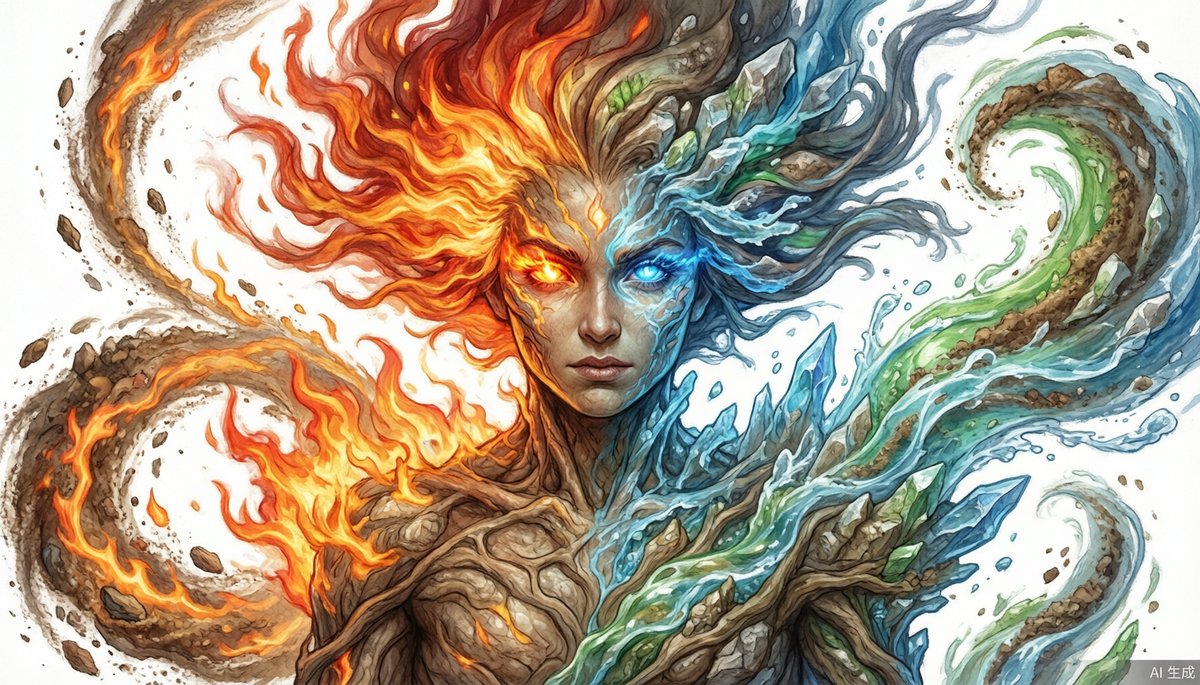
Elemental Blood: How Genasi Names Channel the Four Elements
Genasi naming is unlike any other race in D&D 5e because a genasi's name is not merely a label given at birth. It is a living reflection of elemental power coursing through their blood. When you hear a genasi's name spoken aloud, you are hearing the echo of an elemental plane, the whisper of primordial forces that shaped their ancestors and continues to burn, flow, grind, or blow within them. This makes genasi naming one of the most deeply meaningful and dynamically evolving traditions among the humanoid races of the multiverse.
Understanding how genasi names work requires understanding what genasi are. Born from the union of mortal humans and elemental beings, or from generations of interbreeding where elemental blood remains potent, genasi carry the literal essence of the inner planes in their flesh. Their skin might crackle with tiny flames, their hair might flow like water, their flesh might resemble polished stone, or their bodies might be wreathed in perpetual wind. Their names reflect these physical manifestations with a precision that goes far beyond mere aesthetics.
The Four Elemental Naming Traditions
Each of the four elemental planes has developed its own linguistic tradition over millennia of existence. When genasi are named, they draw from the vocabulary, phonetics, and spiritual resonance of their ancestral plane. These are not arbitrary choices. A fire genasi given a water-sounding name would experience what elemental scholars call "name dissonance" — a subtle but persistent conflict between their identity and their elemental nature that can manifest as physical discomfort, magical instability, or emotional distress.
Fire Genasi: The Ignan Tradition
Fire genasi names draw from the Ignan dialect of Primordial, the language spoken on the Plane of Fire. These names are characterized by harsh, crackling consonants (K, R, T, SH, Z) and open, blazing vowels (A, O) that evoke the sound of flames consuming fuel. The phonetic structure mimics fire itself: a sharp attack, a sustained burning core, and a decisive end.
- Phonetic Pattern: Hard consonants + open vowels + sharp endings
- Male Examples: Pyrath, Kraznak, Ignarion, Asharak, Torchemon
- Female Examples: Ashara, Kethria, Pyrrha, Blazelet, Scorchia
- Common Titles: the Burning, the Undimmed, Flameheart, Ashwalker, the Eternal Coal
- Plane-Born Variant: Names from the Plane of Fire incorporate efreeti morphemes and syllables that literally radiate heat when spoken by those with elemental sensitivity
The Ignan tradition holds that a fire genasi's name should feel like holding an ember: warm, dangerous, and impossible to ignore.
Water Genasi: The Thalassic Tradition
Water genasi names flow from the Thalassic dialect, named for the vast elemental waters that comprise the Plane of Water. These names use liquid consonants (L, M, N, R, TH) and vowels that glide into one another (AE, IA, OE, U) creating a sense of continuous motion. The phonetic structure mirrors water itself: fluid, adaptive, capable of both gentle lapping and crushing depth pressure.
- Phonetic Pattern: Liquid consonants + gliding vowels + flowing rhythm
- Male Examples: Marinth, Thalor, Nereidan, Coralis, Deepcurrent
- Female Examples: Nereida, Thalassa, Marindelle, Oceana, Tidelily
- Common Titles: the Tidecaller, Depthsworn, Wavecrest, the Drowning, Mistwalker
- Plane-Born Variant: Names from the Plane of Water incorporate marid morphemes and syllables that sound like water flowing over stones when spoken aloud
The Thalassic tradition teaches that a water genasi's name should feel like submerging your hand in a mountain stream: cool, refreshing, and subtly powerful.
Earth Genasi: The Chthonic Tradition
Earth genasi names are grounded in the Chthonic dialect, drawn from the Plane of Earth's vast caverns and endless mineral depths. These names use heavy, percussive consonants (B, D, G, K, R) and low, resonant vowels (O, U, AU) that evoke the sound of grinding stone and shifting tectonic plates. The phonetic structure mirrors earth itself: solid, immovable, patient beyond mortal comprehension.
- Phonetic Pattern: Heavy consonants + low vowels + grounded rhythm
- Male Examples: Granit, Basaltor, Terrak, Dorghun, Kragmor
- Female Examples: Terrana, Gemara, Obsidia, Crystalde, Shaleia
- Common Titles: the Unyielding, Stoneborn, Ironvein, the Mountain, Deepdelver
- Plane-Born Variant: Names from the Plane of Earth incorporate dao morphemes and syllables that resonate at frequencies felt rather than heard
The Chthonic tradition says an earth genasi's name should feel like pressing your palm against a cliff face: solid, ancient, and enduring.
Air Genasi: The Auran Tradition
Air genasi names rise from the Auran dialect of the Plane of Air, where language itself is carried on winds that never stop moving. These names use breathy, sibilant consonants (S, SH, F, TH, H) and light, airy vowels (I, E, AE, Y) that seem to dissolve on the tongue. The phonetic structure mirrors air itself: invisible, omnipresent, impossible to grasp or contain.
- Phonetic Pattern: Breathy consonants + light vowels + dissolving rhythm
- Male Examples: Zephyr, Aeolis, Ventus, Skythorn, Galeon
- Female Examples: Zephyra, Aella, Faelis, Breezanna, Cirria
- Common Titles: the Stormborn, Windwalker, Skytouched, the Unfettered, Cloud dancer
- Plane-Born Variant: Names from the Plane of Air incorporate djinni morphemes and syllables that seem to echo with distant thunder when spoken with conviction
The Auran tradition holds that an air genasi's name should feel like catching a breath of wind in a sail: free, exhilarating, and always moving forward.
The Elemental Title: More Than a Surname
Perhaps the most distinctive feature of genasi naming is the elemental title — a descriptor added to a genasi's given name that reflects their strongest elemental affinity, their most significant elemental experience, or the nature of their connection to their ancestral plane. Unlike human surnames that pass from parent to child, elemental titles are deeply personal and can change throughout a genasi's lifetime.
An elemental title is not chosen arbitrarily. It is either earned through a significant feat related to their element, revealed through a spiritual experience, or bestowed by an elder of their elemental community who can sense the genasi's true elemental resonance. The process varies by tradition:
Mixed-Element Genasi: The Blending of Names
Not all genasi inherit a single, pure elemental bloodline. Mixed-element genasi — those whose ancestry draws from two or more elemental planes — face a naming challenge that pure-blooded genasi never encounter. Their elemental heritage is divided, and their name must somehow reflect this internal complexity.
The most common approach among mixed genasi is to adopt a blended name that incorporates phonetic elements from multiple traditions. A fire-water genasi might combine the sharp consonants of Ignan with the flowing vowels of Thalassic, creating a name like "Kaelith" or "Pyrandelle" that sounds simultaneously dangerous and graceful. These blended names are often more complex than pure-element names, with additional syllables representing the interplay between their inherited elements.
Some mixed genasi take a different approach entirely: they adopt dual names, one for each elemental heritage. They use their fire name when working with fire magic or among fire-aligned communities, and their water name when dealing with water-related matters. This practice, called "the Dual Speaking," is considered somewhat unusual by pure-element genasi but is deeply respected as an acknowledgment of the complexity of mixed heritage.
The rarest approach is the synthesis name, where a mixed genasi creates an entirely new name that represents not the blending of their elements but the emergence of something new. A fire-earth genasi who synthesizes their heritage might call themselves "Magmara," a name that evokes molten rock — neither purely fire nor purely earth, but something born from their union. Synthesis names are considered the most authentic expression of mixed-element identity, but they require a deep understanding of both elemental traditions to create properly.
Plane-Born Naming: How Origin Affects the Name
A genasi whose ancestor stepped directly from an elemental plane carries a stronger elemental resonance than one whose heritage has been diluted through generations on the Material Plane. This difference is audible in their names.
First-generation genasi (those born to one elemental parent and one mortal parent) typically have names that are almost entirely drawn from their elemental parent's linguistic tradition. A first-generation fire genasi born to an efreeti father might be named "Baloraxion" — a name that is essentially Efreeti with only minor modifications for mortal tongues. These names are long, complex, and carry overtones of power that make other genasi instinctively defer to their bearers.
Second and third-generation genasi have names that blend elemental and mortal linguistic elements more evenly. "Kraznak" is clearly a fire genasi name, but it has been shortened and simplified from what would have been a much longer Efreeti original. These names are the most common among adventuring genasi, as they are pronounceable by other races while still carrying enough elemental resonance to satisfy the genasi's inner nature.
Later-generation genasi (those whose elemental heritage is many generations removed) often have names that sound almost entirely mortal to untrained ears. "Ash" might be a fire genasi whose name could pass for a human nickname, but the single syllable carries a subtle heat that those sensitive to elemental energy can detect. These genasi sometimes struggle with their identity, feeling that their names do not adequately represent their elemental heritage even though the power still burns within them.
When Elemental Affinity Shifts: The Name Transformation
One of the most fascinating aspects of genasi naming is that it is not permanent. A genasi's elemental affinity can shift over their lifetime, and when it does, their name shifts with it. This is not a casual decision — elemental shifts are profound spiritual events that reshape the genasi's relationship with the fundamental forces of the multiverse.
The most common trigger for an elemental shift is a traumatic experience involving a different element. A fire genasi who nearly drowns and is rescued by a water elemental might find their inner flame dimming as water energy begins to flow through them. Over weeks or months, their physical appearance changes — flames along their arms soften to flowing water patterns, their hair begins to move like currents, and their skin takes on a blue-green sheen. When the transformation is complete, they adopt a new name from the Thalassic tradition.
Another common trigger is deliberate elemental training. Some genasi, particularly those who follow the path of the elemental monk or the genasi sorcerer, intentionally cultivate a secondary elemental affinity to expand their magical capabilities. This training can eventually shift their primary elemental resonance, requiring a name change. Such genasi are respected for their dedication but also pitied, as the name-change ritual involves publicly mourning the loss of their original elemental identity.
The rarest form of elemental shift is the paradox transformation, where a genasi develops affinities for two opposing elements simultaneously. A fire genasi who also develops water affinity becomes a living contradiction — steam constantly rises from their body, and their name must incorporate both Ignan and Thalassic elements in a way that creates a new linguistic form. These paradox genasi are exceedingly rare and are often sought out as advisors on matters that require understanding of opposing forces.
The Sha'ir Tradition: Elemental Pact Naming
Among the most spiritually significant naming traditions is that of the Sha'ir genasi — genasi who have entered into formal pacts with elemental entities. This tradition, most common in the deserts of Zakhara and among planar scholars, adds a layer of complexity to genasi naming that reflects the genasi's relationship with their patron.
When a genasi enters into an elemental pact, they receive a pact name that is distinct from their birth name. This pact name incorporates syllables from both the genasi's original name and their patron's true name, creating a linguistic bond that strengthens their elemental connection. The pact name is used in ritual contexts, when calling upon their patron's power, and when interacting with other beings from their patron's elemental plane.
The Sha'ir tradition also recognizes ascending pacts, where a genasi forms relationships with multiple elemental patrons over their lifetime. Each new pact adds syllables to their pact name, making it progressively longer and more complex. A genasi who has pacted with four elemental lords might carry a name like "Pyraxibal-Marindora-Kragventis-Aeolpyrr" — a name that takes several minutes to speak properly and carries the combined resonance of all four elemental planes. These ascending pact names are considered among the most powerful words in the mortal languages, and speaking one with proper pronunciation is said to briefly open a conduit to the elemental planes.
It is important to note that pact names are considered sacred and private. Revealing your pact name to an enemy is thought to weaken your elemental bond, as it gives them power over the linguistic thread that connects you to your patron. Most genasi in the Sha'ir tradition have a public name (their birth name or elemental title) and a private pact name that they share only with trusted allies and their patron.
How Genasi Names Change With Elemental Affinity
The relationship between a genasi and their element is not static. Just as a river changes course over centuries, a genasi's elemental affinity can shift, deepen, or transform over their lifetime. When this happens, their name must change to reflect their new reality.
Deepening affinity: A fire genasi whose connection to flame grows stronger might add intensifying syllables to their name. "Kraz" might become "Kraznak" and eventually "Kraznakar" as their power grows. Each additional syllable represents a deeper level of elemental commitment and is earned through significant feats of elemental mastery.
Broadening affinity: A genasi who develops competence in a secondary element (without shifting their primary affinity) might add a modifier to their name. "Pyrath the Burning" might become "Pyrath the Burning-Steam" if they develop water abilities that create steam when combined with their fire. These compound titles are common among adventurer genasi who need to represent their diverse capabilities.
Transforming affinity: In rare cases, a genasi's primary elemental affinity completely transforms from one element to another. This is the most dramatic form of name change and is accompanied by a physical transformation that can take weeks. The old name is formally abandoned in a ceremony called the "Speaking Out," where the genasi speaks their old name one final time and then declares it dead. The new name is received in a separate ceremony called the "Speaking In," where elders of the new elemental tradition bestow a name that matches the genasi's transformed nature.
Complete Character Examples by Element Type
The following characters demonstrate how genasi naming conventions create rich, meaningful identities that reflect each character's elemental heritage, personal history, and adventuring role.
Pyrath the Burning
Race & Class
Fire Genasi Sorcerer (Draconic Bloodline — Red Dragon) Level 7
Background
Sage — Elemental Historian
Personality
Pyrath is intense, passionate, and quick to anger — but equally quick to forgive. His hair is literally made of flickering flames that blaze brighter when he is emotional. He speaks with a crackling emphasis on consonants that makes other fire genasi instinctively respect him. He is obsessed with the history of the Plane of Fire and collects ancient Ignan texts that most scholars cannot even pronounce, let alone translate. Despite his fiery temperament, he is a patient researcher who will spend weeks deciphering a single tablet if the knowledge it contains is valuable enough.
Adventuring Motivation
Searching for the legendary Flame Archive, a library said to exist at the heart of the Plane of Fire that contains every spell ever created using fire magic. He believes that recovering even a fraction of its contents would revolutionize arcane scholarship.
Marinth the Tidecaller
Race & Class
Water Genasi Druid (Circle of the Sea) Level 5
Background
Outlander — Deep Sea Explorer
Personality
Marinth is calm, patient, and deeply contemplative, like the ocean depths she draws her power from. Her skin has a faint blue sheen, and her hair moves constantly as if she is always underwater. She speaks slowly and deliberately, choosing words with the care of someone navigating a reef. She has an unusual ability to sense water currents and can navigate any body of water by taste alone. Her temperament mirrors the sea: peaceful most of the time, but capable of terrifying fury when provoked.
Adventuring Motivation
A massive underwater earthquake has disrupted the ocean currents that sustain the coral reef ecosystem near her coastal home. She is seeking the source of the disturbance and a way to restore the natural flow before an entire marine ecosystem collapses.
Granit the Unyielding
Race & Class
Earth Genasi Fighter (Battle Master) Level 8
Background
Soldier — Mountain Fortress Guard
Personality
Granit is exactly what his name suggests: solid, immovable, and patient beyond measure. His skin has the texture and color of weathered granite, and small crystal formations grow along his forearms that he polishes daily. He speaks rarely, but when he does, his words carry the weight of geological time. He is the type of warrior who will stand in one position for hours without moving, waiting for the perfect moment to strike. His comrades joke that he is literally part of the battlefield.
Adventuring Motivation
A mining operation has broken through into an ancient underground cavern system, releasing creatures that have been sealed beneath the earth for millennia. Granit has sworn to seal the breach before the creatures reach the surface, using his knowledge of stone and earth to collapse the tunnels permanently.
Zephyra the Stormborn
Race & Class
Air Genasi Monk (Way of the Four Elements) Level 6
Background
Hermit — Mountain Ascetic
Personality
Zephyra is restless, quick, and impossible to pin down — both literally and figuratively. Her body is surrounded by a perpetual gentle breeze that strengthens when she is excited or angry. She moves with fluid grace, never sitting still for long, and her thoughts jump from topic to topic like wind gusting through a canyon. She trained for twenty years at a monastery perched on the highest peak of a mountain range, learning to channel the elemental forces of air through martial discipline. Despite her flighty nature, she is deeply committed to her principles and will fight fiercely to protect those who cannot protect themselves.
Adventuring Motivation
The winds have changed. The great air currents that circle the world have begun to shift unpredictably, causing storms where there should be calm and drought where there should be rain. Zephyra believes something is disrupting the elemental flow of air itself, and she must find the source before the world's weather patterns collapse entirely.
Kaelith Flame-and-Tide
Race & Class
Mixed Genasi (Fire/Water) Warlock (Genius Patron — the Genie of Steam) Level 4
Background
Charlatan — Traveling Mysticism
Personality
Kaelith exists in a state of constant elemental tension. Half their body radiates heat while the other half is cool to the touch, and steam perpetually rises from where the two temperatures meet at their midline. Their hair is a striking half-red, half-blue that seems to boil and flow simultaneously. This internal conflict has made them adaptable and creative — they have learned to use the tension between their elements as a source of power rather than a weakness. They are charming, quick-witted, and slightly unpredictable, never quite sure which elemental mood they will be in from one moment to the next.
Adventuring Motivation
Kaelith has attracted the attention of a powerful steam genie who sees in them the potential to become a champion of the rare elemental paradox — the meeting of fire and water that creates steam. The genie has offered power and knowledge in exchange for completing a series of tasks that will test both halves of Kaelith's nature simultaneously.
Common Genasi Naming Mistakes (And How to Avoid Them)
Mistake #1: Ignoring Elemental Phonetics
Wrong: Naming a fire genasi "Lily" or a water genasi "Krag"
Why it's wrong: Each elemental tradition has specific phonetic patterns. Fire names need harsh consonants; water names need flowing sounds. Ignoring these patterns creates name dissonance that undermines the character's elemental identity.
Fix: Match phonetic patterns to element: fire genasi get names like "Kraznak" or "Ashara"; water genasi get names like "Marinth" or "Nereida."
Mistake #2: Forgetting the Elemental Title
Wrong: "Pyrath" with no title or descriptor
Why it's wrong: The elemental title is what distinguishes a genasi name from a merely exotic-sounding name. Without it, you lose the most meaningful part of the naming tradition.
Fix: Always include a title: "Pyrath the Burning," "Marinth the Tidecaller," "Granit the Unyielding."
Mistake #3: Treating All Genasi the Same
Wrong: Giving a first-generation genasi the same name style as a fifth-generation genasi
Why it's wrong: The strength of elemental blood directly affects naming. First-generation genasi have longer, more complex names drawn directly from elemental languages. Later generations have simpler, more assimilated names.
Fix: Consider generational distance: first-gen "Baloraxion" vs. third-gen "Kraz" vs. fifth-gen "Ash."
Mistake #4: Static Names for Dynamic Beings
Wrong: A genasi who has undergone a major elemental shift still using their birth name
Why it's wrong: Genasi names reflect current elemental reality. A fire genasi who has shifted to water affinity would experience genuine distress continuing to use a fire name that no longer matches their nature.
Fix: Allow names to evolve with the character's elemental journey. Name changes should mark major story milestones.
Using Genasi Names in Your Campaign
For Players: Building Your Genasi's Elemental Identity
- Determine your elemental heritage first — this is the foundation of your naming tradition
- Choose your generational distance — first-generation names are complex; later-generation names are simpler
- Select or earn your elemental title — this should reflect a significant event in your character's history
- Consider if your name might change — think about your character's arc and whether their elemental affinity might shift
- Learn the pronunciation — your name should sound like your element when spoken aloud
For DMs: Genasi NPCs and Plot Hooks
Genasi names create instant story hooks:
- Pyrath the Burning — an ancient fire genasi sage who knows the location of the Flame Archive but will only reveal it to someone who can correctly pronounce his full pact name
- Marinth the Tidecaller — a water genasi hermit who can calm the seas but demands a terrible price for her service
- Kaelith Flame-and-Tide — a mixed genasi con artist whose elemental instability makes them unpredictable but also capable of surprising feats of power
- Zephyra the Stormborn — a monk who has detected a disturbance in the world's air currents and needs allies to investigate
Names as Elemental Storytelling
Genasi naming conventions allow for unique narrative elements:
- Early Campaign: Your genasi carries their birth name and has not yet earned an elemental title
- Mid Campaign: They earn their first title through a significant elemental feat, marking their growth
- Late Campaign: Their elemental affinity shifts or deepens, requiring a name transformation that reflects their evolution
- Endgame: They may receive a pact name from an elemental lord, adding the final layer to their elemental identity
This creates a character arc that is literally spoken every time someone addresses them — something unique to genasi among all D&D races.
The Deep Linguistics of Elemental Names
To truly understand genasi naming, one must appreciate the linguistic foundations that underlie each elemental tradition. The four elemental dialects of Primordial are not merely different accents of the same language — they are fundamentally distinct linguistic systems with their own grammar, phonology, and semantic frameworks.
Ignan (Fire Language): The language of the Plane of Fire is characterized by its explosive phonetics. Words in Ignan are typically short and percussive, designed to be shouted over the roar of eternal flames. The grammar is direct and imperative — there is no subjunctive mood in Ignan because the Plane of Fire does not deal in possibilities, only in the absolute reality of combustion. Fire genasi names preserve these linguistic features, using staccato syllables that sound like sparks popping from a flame.
Thalassic (Water Language): The language of the Plane of Water is fluid and contextual. Words in Thalassic change meaning based on the "current" of the conversation — the same syllable sequence can mean "ocean" or "teardrop" depending on the emotional flow of the speaker. The grammar is circular rather than linear, with sentences that loop back on themselves like eddies in a stream. Water genasi names preserve this fluidity, using syllables that flow into one another without clear boundaries.
Chthonic (Earth Language): The language of the Plane of Earth is slow and resonant. Words in Chthonic are deliberately long, as the earth has no patience for haste. A single Chthonic word might take several minutes to pronounce properly, as each syllable must be given its full geological weight. The grammar is layered, with meanings building up like sediment over time. Earth genasi names are necessarily abbreviated versions of what would be full Chthonic names, but even these shortened forms carry a resonance that makes other genasi feel the weight of the earth beneath their feet.
Auran (Air Language): The language of the Plane of Air is ephemeral and ever-changing. Words in Auran are never spoken the same way twice, as the wind carries them in different directions each time. The grammar is based on movement and direction rather than subject and object — in Auran, you do not say "I hit the target" but rather "force moves from me toward that which receives." Air genasi names capture this sense of perpetual motion, using sounds that seem to shift and change even as they are being spoken.
Understanding these linguistic foundations helps players and DMs create genasi names that feel authentic rather than merely exotic. A properly constructed genasi name does not just sound interesting — it sounds like a fragment of an elemental plane has been compressed into a few syllables and given to a mortal being to carry as their identity.
Elemental Ceremonies and Name Bestowal
The process of receiving a genasi name is itself a significant cultural event. Among elemental communities, name bestowal ceremonies are considered sacred rituals that connect the named individual to the fundamental forces of the multiverse.
Birth Naming: When a genasi child is born, the community gathers to determine their elemental affinity. This is done through the "Elemental Reach" ceremony, where the infant is placed in a circle surrounded by representations of the four elements — a candle, a bowl of water, a stone, and a feather. The element the child reaches for first (or reacts to most strongly) determines their naming tradition. In cases where the child shows equal interest in multiple elements, they are identified as mixed-element and given a blended naming ceremony.
Title Bestowal: When a genasi earns their elemental title, the ceremony is more elaborate. For fire genasi, the title is bestowed in the "Kindling Ritual," where the community lights a flame in the genasi's honor that must burn continuously for one full year. For water genasi, the "Deep Immersion" ceremony involves the genasi submerging themselves in a body of water while the community sings traditional Thalassic hymns. Earth genasi undergo the "Stone Embrace," where they are buried up to their necks in earth for a full day while elders commune with the elemental forces below. Air genasi receive their titles in the "Wind Calling," where they must stand on a high place and call out their desired title into the wind — if the wind carries their voice clearly, the title is accepted.
Name Transformation: When a genasi's elemental affinity shifts, the old name must be formally released. This "Speaking Out" ceremony is somber and emotional, as the community acknowledges that the person they knew has fundamentally changed. The genasi speaks their old name one final time, then closes their mouth and remains silent until the new name is bestowed in the "Speaking In" ceremony. The silence between names is considered a sacred space where the genasi exists in elemental transition, neither their old self nor their new one.
Regional Variations in Genasi Naming
Genasi naming traditions are not monolithic. Different regions of the world have developed their own variations on the elemental naming system, influenced by local cultures, languages, and the specific elemental forces prevalent in the area.
Calimshan Genasi: In the desert lands of Calimshan, genasi are more common than almost anywhere else in the world, thanks to the historical presence of djinn and efreet in the region. Calimshan genasi often incorporate local linguistic elements into their elemental names, creating hybrid forms that sound distinctly Zakharan. A Calimshan fire genasi might be named "Khalid al-Pyrath" — combining the local naming convention of "al-" prefixes with the traditional Ignan root for fire.
Northern Genasi: Genasi from the frozen north tend to have shorter, harder names regardless of their elemental affinity, as the harsh climate has influenced even the way elemental languages are spoken in those regions. A northern air genasi might be named "Frost" rather than "Zephyra," reflecting the cold, biting quality of northern winds.
Island Genasi: Genasi from island communities often have names that blend multiple elemental traditions, reflecting the way islands exist at the meeting point of multiple elements — earth surrounded by water, heated by fire (volcanic islands), and battered by air (storms). These multi-elemental names are considered particularly auspicious and are often given to children born during storms or volcanic eruptions.
Adventuring Party Dynamics and Genasi Names
When a genasi joins an adventuring party, their name becomes a point of interaction and sometimes confusion. Other races often struggle to pronounce elemental names correctly, and genasi can be particular about how their names are spoken.
Common abbreviations: Many adventuring genasi adopt shortened versions of their names for use with non-genasi companions. "Pyrath the Burning" might go by "Py" among friends, while "Marinth the Tidecaller" might accept "Mari" from those who struggle with the full Thalassic pronunciation. These abbreviations are considered informal and intimate — using them signals a close relationship.
Title translation: Elemental titles do not always translate cleanly into Common. "The Unyielding" is the Common rendering of a Chthonic title that more precisely means "one who has become as the deepest stone, which moves only when the continents themselves shift." Some genasi insist on the full translation, while others accept the abbreviated Common form. This can be a source of gentle humor in mixed-race parties.
Mispronunciation consequences: In elemental traditions, mispronouncing a genasi's name is not merely a social faux pas — it can have minor magical consequences. Speaking a fire genasi's name with water-sounding vowels might cause a brief flare of steam. Getting an air genasi's name wrong might create a small gust of wind. These effects are harmless but annoying, and genasi learn to be patient with companions who are still learning the correct pronunciations.
How to Use the Genasi Name Generator
Choose Your Element
Select fire, water, earth, air, or mixed elemental heritage. Each element has distinct phonetic patterns and naming traditions that reflect the genasi's ancestral plane and elemental nature.
Understand the Etymology
Every generated name includes a breakdown showing its linguistic roots in the Primordial dialects. Learn how Ignan, Thalassic, Chthonic, and Auran patterns create authentic elemental names.
Generate Character Cards
Switch to Character Generator mode to create complete genasi characters with class, background, personality traits, elemental titles, and AI portrait prompts for your campaign.
Frequently Asked Questions
How do genasi names reflect their elemental heritage?
Genasi names are directly drawn from the vocabulary of their elemental ancestry. Fire genasi use harsh, crackling consonants and flame-related morphemes like Ignis, Ashara, or Pyrath. Water genasi favor flowing syllables with liquid consonants such as Marinth, Nereida, or Thalassa. Earth genasi employ heavy, grounded sounds like Granit, Basalt, or Terran. Air genasi use breathy, light phonemes such as Zephyr, Aeolis, or Ventus. Each elemental tradition has distinct phonetic patterns that make a genasi's heritage audible the moment their name is spoken.
What is the elemental title system for genasi?
The elemental title is a descriptor added to a genasi's name that reflects their strongest elemental affinity or most significant elemental experience. Unlike surnames, these titles are earned or revealed through manifesting elemental power. Examples include 'the Burning' for fire genasi who have survived immersion in flame, 'the Tidecaller' for water genasi who command currents, 'the Unyielding' for earth genasi who have withstood tremendous force, and 'the Stormborn' for air genasi touched by lightning. A genasi may hold only one title at a time, and it changes when their elemental affinity shifts.
How do mixed-element genasi choose their names?
Mixed-element genasi face a unique naming challenge. Most choose to reflect their dominant elemental affinity in their primary name, then incorporate elements of their secondary heritage into their title or adopt a blended name that merges phonetic patterns from both traditions. For example, a fire-water genasi might use a name like 'Kaelith' that combines the sharp 'K' of fire naming with the flowing 'ith' of water naming. Some mixed genasi adopt two names entirely, using one in elemental communities aligned with their fire side and another among communities aligned with their water side.
Do genasi from different elemental planes name their children differently?
Yes, plane of origin significantly influences genasi naming. Genasi whose ancestors came from the Plane of Fire tend to have names that evoke volcanic destruction and eternal flame, using words from Primordial's Ignan dialect. Those from the Plane of Water draw from the Thalassic dialect, with names that reference oceanic depths, tidal forces, and drowning currents. Plane of Earth genasi use Chthonic dialect patterns, with names sounding like grinding stone and shifting tectonic plates. Plane of Air genasi employ the Auran dialect, with names that seem to dissolve on the tongue like mist.
Can a genasi's name change when their elemental affinity shifts?
Absolutely. Genasi elemental affinity is not always static. A fire genasi who undergoes a profound spiritual transformation might find their inner flame dimming while water-like adaptability emerges. When this happens, many genasi formally adopt a new name through an elemental ceremony. This name-change ritual varies by tradition but typically involves exposing the genasi to their new elemental affinity until their body physically reflects the change. The old name is spoken one final time and then abandoned, as continuing to use it would create dissonance between the genasi's identity and their evolving nature.
What is the Sha'ir naming tradition for genasi?
Sha'ir genasi follow a special naming tradition rooted in their elemental pacts. When a genasi enters into a pact with an elemental entity, they receive a pact name that incorporates syllables from both their own name and their patron's true name. This pact name is used only in ritual contexts and when calling upon their patron's power. For example, a fire genasi named 'Pyrath' who pacts with an efreeti lord called 'Balorax' might receive the pact name 'Pyraxibal' or 'Balopyr.' The pact name is considered sacred and revealing it to enemies is thought to weaken the elemental bond.
What are common genasi naming mistakes to avoid?
The most common mistakes include using generic fantasy names without elemental phonetic patterns, ignoring the distinction between elemental traditions, giving a fire genasi a name that sounds soft and flowing, or failing to include an elemental title. Another frequent error is treating all genasi the same regardless of which elemental plane their ancestors originated from. Fire genasi from the Plane of Fire should sound distinctly different from fire genasi whose elemental heritage is diluted through generations on the Material Plane. Names should always be audible reflections of elemental power.
How long do genasi names typically last?
Genasi names last as long as their elemental affinity remains stable. Since genasi can live as long as humans (and sometimes longer with certain elemental blessings), a fire genasi with a consistent connection to their inner flame might carry the same name for decades. However, elemental shifts, major life events, or changes in their relationship with their ancestral plane can trigger a name change. Some genasi accumulate multiple names over their lifetime, each representing a different phase of their elemental journey. Elders are often addressed by all their accumulated names as a sign of respect for their elemental experiences.