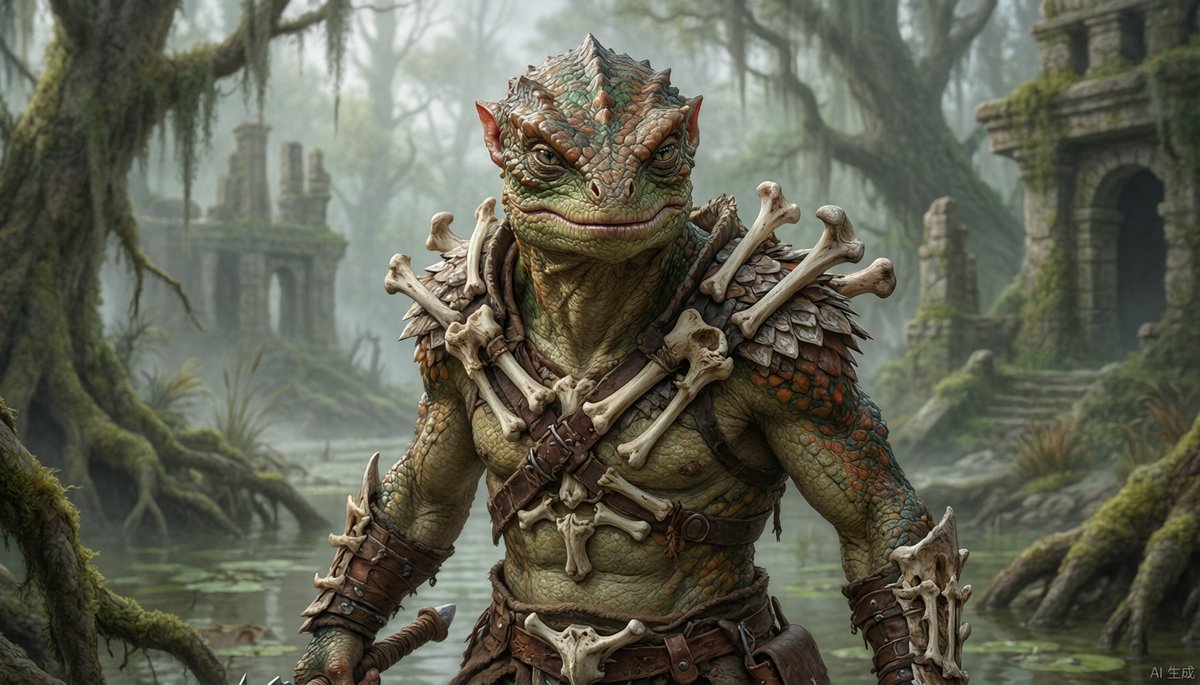
To understand lizardfolk names, you must first abandon everything you know about naming. Forget the melodic elven syllables passed down through centuries of poetry. Forget the dwarven clan-names carved into granite keystones. Forget the human tradition of honoring ancestors, saints, and kings. Lizardfolk do not name their children after grandparents. They do not choose names because they sound beautiful. They do not inherit surnames that connect them to a bloodline stretching back into antiquity. None of these concepts exist in lizardfolk culture, and attempting to map humanoid naming logic onto reptilian identity is like attempting to understand fish by studying birds -- the fundamental premises are wrong.
Lizardfolk are, above all else, practical. Every aspect of their culture -- every behavior, every ritual, every social structure -- exists because it serves survival. They live in environments that want them dead: swamps teeming with crocodiles, jungles choking with predators, deserts baking under merciless suns. In such an existence, nothing is wasted. Not food, not energy, not words. And certainly not names. A lizardfolk's name is a tool, and like every tool in their repertoire, it exists to do a job. The job of a name is to communicate useful information about the lizardfolk who carries it. Nothing more. Nothing less.
This produces a naming system that other races find deeply alien. When a human adventurer asks a lizardfolk their name and receives the answer "Sharptooth," they assume this is a nickname, a translation, or perhaps a childhood moniker that the lizardfolk never bothered to change. They are wrong on every count. "Sharptooth" is the lizardfolk's name because "Sharptooth" accurately describes something true and useful about the lizardfolk at this moment in their life. It is not sentimental. It is not hereditary. It is not permanent. It simply is -- for now.
The Two Names: Draconic Truth and Common Utility
Every lizardfolk carries two names, though they would not describe the distinction in those terms. Among their own kind, lizardfolk use complex Draconic names that are essentially unpronounceable by humanoid vocal apparatus. These names are not merely words -- they are multi-layered identifiers incorporating tonal hisses, subvocal rumbles, throat-clicks, and accompanying scent-gestures that convey the lizardfolk's entire survival history in a single utterance.
A Draconic name like Sset'hk'thiss is not "pronounced" in any way a human could replicate. The apostrophes represent glottal stops -- moments where the lizardfolk cuts off airflow and redirects it through their nasal cavity while simultaneously producing a low-frequency chest rumble. The doubled consonants indicate held sounds, where the hissing continues for a precisely measured duration that carries meaning. The capital letters mark stress-points where the volume or pitch shifts significantly. And this is only the audible component -- the full name includes scent-gestures produced by specialized scales along the jawline that release pheromone traces during the speaking.
Male: Sset'hk'thiss, Irhtos'kith, Othok'theg, Aksa'feth, Vith'marok, Kress'thalak, Ghaz'keth, Thass'virik
Female: Irthi'sek, Othoka'las, Aksa'thiss, Vress'kitha, Ghazzi'vel, Thass'lekith, Kressi'thara, Irhtosi'la
Gender-neutral: Sseth'mara, Okoth'ge, Vith'akso, Ghaz'thress, Kressi'oth, Irth'vok, Thass'okhi, Oth'kress
When lizardfolk interact with other races, they adopt a Common tongue name -- a simplified, single-word label that humanoids can pronounce and remember. This name is chosen by the lizardfolk themselves, usually based on a notable survival achievement or a useful physical characteristic. The Common name is, from the lizardfolk's perspective, a trade-token: a simplified version of their true identity designed for creatures too limited to comprehend the full Draconic original.
Lizardfolk do not feel insulted by this simplification. They feel the way a master craftsman feels when reducing a complex blueprint to a sketch for an apprentice -- it is necessary, practical, and slightly condescending, but not offensive. The humanoid gets a functional name. The lizardfolk keeps their true identity intact. Everyone benefits.
Sharptooth -- Named after first successful hunt with teeth alone (no weapon)
Quickswim -- Named for outrunning a river crocodile in open water
Stillwatch -- Named for maintaining perfect stillness during a three-day sentry vigil
Stonehide -- Named for surviving a fall from a cliff into rocky shallows
Mudstrider -- Named for leading the tribe through an impassable marsh
Bonecarver -- Named for crafting the tribe's first bone-tipped spear
Firekeeper -- Named for maintaining the tribe's fire through a week-long storm
Deepdiver -- Named for retrieving a sacred totem from the bottom of a cenote